
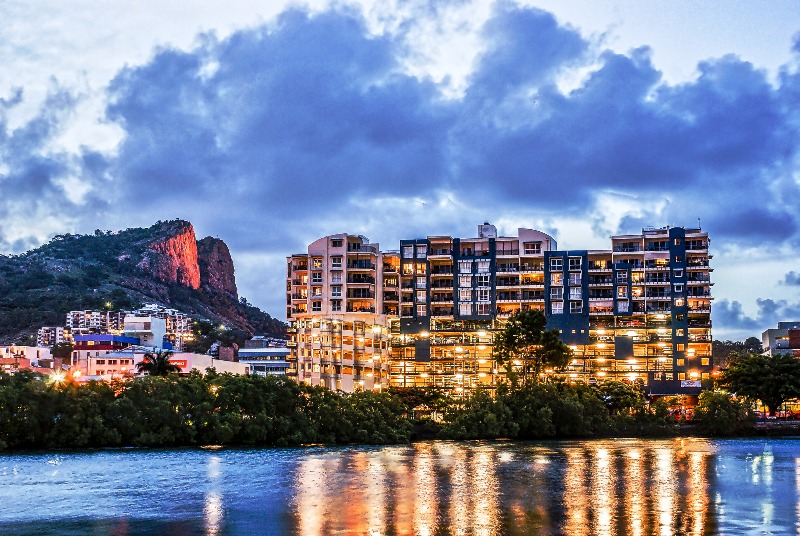
Townsville’s existing hotel property owners have expressed stiff opposition to the Townsville City Council’s exclusive negotiations with Hilton Hotels to construct a proposed 175 bed 4.5 star Double Tree hotel next to the North Queensland stadium.
With fair reason, the Grand Chancellor, Grand Hotel and Mercure Inn managers share the same concern that Townsville’s visitations cannot support another hotel in the City. The hospitality and short term accommodation experts say the City has the highest vacancy rates in the hotel market across the country.
Unless the stadium attracts more events and conferences then existing infrastructure, adding accommodation capacity to the City is only going to hurt local businesses and residents even more than what has already occurred.
Broken Record of Conflicts
Townsville City Council has a brazen track record of disadvantaging local contributors and small to medium size local investors. The Council sounds like a “broken record” in its exclusive business plan to attract the next cashed up property investors to stimulate jobs and rescue the City.
Just like the property spruikers and trusted military leadership exploiting our veteran soldiers who lost millions from dodgy investments in government sponsored housing, the local and state government authorities are tinkering on the edge of exploiting its own residents and thwarting balanced and unbiased governance practices.
Remarks by local government leaders such as Deputy Mayor Les Walker saying, “Hilton hotel wanting to invest in the City is a vote of confidence” is patronising and insensitive of the incumbent contributors.
The Treasurer Curtis Pitt said a similar statement regarding the Queensland Investment Corporation (QIC) investment in the $6 million upgrade of Domain Central shopping centre. QIC is owned 100% by the Treasurer and Premier yet it was presented to the Townsville public as though a private investor was boasting about the Townsville marketplace even though the company’s annual report stated that property management investment was unfavourable.
Stadium failure justification
Even though the Council is actively seeking a big brand hotel to justify the unpopular investment of the North Queensland stadium, the parties are being controlled via a memorandum of understanding (MoU). The new stadium has nearly the same number of seats as the old stadium at the Willows, having a negligible impact on attracting more visitors to the City.
For readers that pay little attention to the media environment on a regular basis, it may come as a surprise to learn that all major economic investments impacting small business and employment are controlled and released by a government agency before the release by the private partner company. Governments, more than ever before, are controlling the public information and media cycle, at least in Townsville.
Even the editor of the Townsville Bulletin, Mr. Ben English fuels the flames of Council’s nearsightedness saying “Competition drives success. It also provides good outcomes for consumers.” One wonders why News Ltd wants less competition in the Australian media landscape in the context of this editorial rant. Ask Victoria and South Australia how has competition affected their electricity bills lately?
However, Mr. English went on and said: “In this light, it is hard to side with the Townsville hoteliers who are resisting plans…” Yet the editor declared the conditions in the City “unpalatable realities”. In other words, leave the soap in your mouth because the truth and innovative views will be washed out as foul language.
But still Mr. English dismissed the hoteliers’ desire for a greater focus on sustainable visitors to justify developments that are attracting financial or cost saving incentives by the government when such measures were not afforded to the hoteliers’ businesses. The Priority Development Area (PDA) in which the Hilton site is proposed will be applicable for “Area A” infrastructure offsets, meaning the normal headworks costs for a new hotel development will be substantially discounted by hundreds of thousands of dollars through State government funding.
Councillors, developers and the media are either board, committee or partnership representatives in the institutions that have curated the business plans for the City. Therefore, they are vested by reputation in selling the “build it and they will come” plans around the stadium monument. New buildings are visible news stories for national and even international consumption.
The Waterfront Priority Development Area has drawn significant attention to the City in an effort to stimulate visitor inflows. The stadium will be the first major development since the scheme was signed off in 2015.
As with Council, Townsville Enterprise and the entire structure of civil institutions are backed by the media conglomerate, who suggested the hoteliers and the Council best keep the “shutters open” for all construction projects and development strategies. In spite of the fact this unintelligent and overly simplistic approach has been a major source of pain and suffering for the City’s population and economy over the past 10 years.
“A community that embraces creativity facilitates new ways of thinking, and a willingness to think through problems afresh, to experiment and rewrite rules to harness new technology and to visualise new futures.” Pure Projects Report.
Marcus Westbury, entrepreneur and festival organiser from Newcastle who championed that City’s revival said: “The problem wasn’t a hardware or capital works issue but a software issue.”
Considering the losses that have been incurred by the City in social and economic terms, it’s hard to imagine a vested player advocating for excessive hardware developments calling for a royal commission any day soon.
Build hotel and they will come
The “build it and they will come approach” is irresponsible, bordering on misfeasance and even negligent to the residents and hard working ratepayers and loyal business operators in the City. It requires balanced and strategic planning, not just a blanket “jobs splash” mentality.
Meanwhile, incumbent investors and retailers are vacating retail properties connected to government and media spruikers because retail rents are too high, building costs are too high and government taxation policies are becoming unfavourable.
Local real estate agents are reporting the number of investors appearing at residential auctions and open houses in the City, including in Cairns, has dropped to the lowest level they’ve seen in 5 years.
The federal government’s budget attracting foreign private capital to build social housing will see this attitude prevail as projects are managed through the City Deal by the local government authority.
How can the City Deal work if the Council is conflicted with social housing, private developments, commercial business exposure against ratepayer interests? Rate payers want sustainable industry and sustainable visitors coming to the City. Not boom and bust spruikers.
Consequences for property owners
Existing property owners are losing profits and wealth. Yields and equity have both dropped because it is easier for Council to entertain suppliers of construction than it is to address accommodation industries and initiatives that drive demand in population and visitor growth.
Just take a look at the Commonwealth Bank (CBA). They just announced a record $9 billion profit in the midst of allegations that billions had been laundered by the bank through their non-compliant ATM machines.
The banks are carrying property developers and governments. So selling the property off the plan (house and land packages) to unsuspecting investors ensures the risk factors for intermediaries are tolerated and in fact encouraged by the banks. Meanwhile, the developers, builders, real estate agents and solicitors pick up transaction fees and charges, etc. And of course, governments generate revenue from taxes, duties, levies, etc. all paid for by consumers on relatively cheap low-interest loans. Group title unit construction projects are lucrative cash cows for the banks and the intermediaries pick up a slice of the pie. It’s smart business! They are highly scalable investments.
For developers, it’s a simple debt to equity ratio and loan to value ratio under management to secure the capital. Effectively both cash flow and security are covered by the investors via deposit contracts and purchase settlements usually 50 percent of the development stock. But once the capital has been secured by small or syndicated institutional investors, the intermediaries effectively transfer the debt to qualify for more capital supply if the projects are commissioned. Meanwhile, the intermediaries and banks have hedged their capital and their risks, leaving the property investors, mostly low to middle-income families, mortgaged and enslaved.
Although this money lending and renting model has been the basis of capitalism for centuries, the Council’s quick fix approach and CBD focus have been damaging to the broader economy. It is dependent on carbon-based mining and manufacturing, social and infrastructure investment which is being threatened by ideological maneuvering around climate change.
Townsville’s incumbent property owners are being exploited by the local government authority, being loaded as a conduit of state and federal schemes such as the City Deal (federal), social housing (federal) and State-sponsored priority developments, effectively operating as a subsidiary corporation of the share holding Ministers and commercial partnership boards.
On one hand generating planning approval revenues and on the other hand, buying favour on the public confidence score card as the leadership is constantly pursuing and facilitating a stimulation bubble.
An election is never far away, so the planning and political cycles begin from day one. So even though “an unpalatable reality” exists, the attitude is that the hard working contributors have to just suck it up because that is the way things are done around here.
Government implicit in the banking
How do you think the share price of the Commonwealth Bank remained without impact even though the company faces nearly $1 trillion in fines for breaching the money laundering laws? Hedge funds and insurances, the same way the Global Financial Crisis unfolded. And the financial services ombudsman can’t even do anything about it.
We see the interests of short sighted governments in the energy generators gouging the consumer with record electricity prices. And now we see a Council wilfully cloud the lines of commercial interest even further, entering into joint ventures with private investors using ratepayer assets in the Council-owned land.
The Council is seeking development approval for essentially commercial enterprise in which they themselves are financial beneficiaries, adding another layer of conflict against ordinary ratepayers, business operators and community contributors.
All of the legal instruments are geared and networked to fuel the profits of global banks fighting for survival in a world of digital decentralisation, drawing equity out of the entire Australian property market to fund investment ventures in developing economies such as Asia, Europe and Africa. If not directly, indirectly through massive government debt. In this context, the CommonwealthBank is untouchable as are the multinational and national corporations.
Losses are happening in residential developments, it is happening in tourism, it is happening in the industry and now the high-end hotel and accommodation market leaders in the City have vented their frustration at the City’s planners and leaders.
Market oversupplied
The long term property markets have been screaming for higher inflows of people to reduce the plus 6 percent vacancy rates in residential housing and plus 15 percent in commercial vacancy rates. Although recent signs of relief have emerged as residential vacancy rates have reduced slightly, mainly due to a slowing of new housing developments. However, a massive 11.7 percent of dwellings in Townsville were unoccupied at the time of the 2016 Census. This is double the vacancy rate reported by property analysts.
The backpacker accommodation market is hurting also as overnight stays in the City had been reported by Townsville Enterprise to have increased over the past 3 years. But the types of visitors coming to the City were found not to be using retail accommodation providers. Instead, visitors are staying in caravans, with family and friends or share accommodation.
The high-end hotel operators are reporting that the full house sign has not been put up in the City for at least 5 years and the occupancy rates today are only 60 percent.
The City is oversupplied with accommodation and the Council has no legal or ethical filter to moderate the impact on ratepayers naively expecting their representatives to serve their interest as residents.
Tony Raggart from the Townsville Bulletin reported that the General Manager of the Grand Chancellor Mr. Paul Gray said “We welcome new development if there is a huge increase in visitation to the region but we haven’t seen any evidence of that in the last few years.
The substantial growth of residents promoting Air BnB to rent out rooms has occurred taking bed nights away from motels and hotels. The early investment adopters and local hotel, motel, backpackers and landlords are being squeezed and even betrayed by excessive approvals by Council of inner city unit developments including some outer subdivisions.
Many dwellings are sold off the plan with furniture packages to investors to accommodate short term and nightly bookings from visitors. The high-end hotel operators are sounding the alarm which has been ringing in the ears of Townsville ratepayers for many years.
How long can existing property investors and accommodation operators tolerate such short sighted development decisions?
Well, they can’t! And the number of bankruptcies, foreclosures, unemployment and suicides in the past 5 years is a testament of successive governments caring less for their own constituents.
Major industries
Townsville residents are being used as a political football and the Clive Palmer Nickel Refinery is a glowing example of the hypocrisy, where the State Labor government refused a $35 million loan to the employer to save 800 jobs but now supports a $900 million loan to attract the same number of jobs on the back of a foreign investor. It just proves that Townsville is the subject of perpetual political bastardry.
Local investments consultancy, McINC has ranked for TREN the feasibility of major projects such as Adani’s exclusive FIFO hub, the NAIF loan for the Adani railway and the Singapore Army training initiative. Defined in the McINC report, the chance of these projects coming to fruition are ranked as highly unlikely to below likely at this point in time.
Governments and civil leaders alike have a lot of work in front of them to secure the huge inflows of visitors and residents needed before the Hilton Hotel is likely to get the green light from the heavy economic lifters in Townsville. Historically, this does not mean it wouldn’t get Council approval.
In this neck of the woods, if a correction in mineral commodity prices and an inept government using toxic politics can bring down 800 blue collar workers at Queensland Nickel after 35 years of loyal continuous service, one can only imagine what respect would be afforded to the next wave of heavy industry and small investors being lobbied around the stadium development.
The mining industry’s decline was foreshadowed years before commodity prices dropped to unsustainable levels. So why such a hostile reaction from the Premier and Mayor towards Qld Nickel, who rescued the refinery from BHP who was going to mothball the plant anyway?
The inevitable adoption of robots by Townsville industry, including government and mining, over the next 5 years is inevitable too. But neither the Mayor or Premier have fessed up to the “unpalatable reality”. Instead, leading the economy and the residents once again to another Qld Nickel scenario is the fault of industry and opposition governments.
Who will cop the blame this time? Facebook, Google, or Glencorp or the Hilton hotels? It could be anyone guess. But we can be assured it won’t be the nearsighted media editors or Councillors to blame because “unpalatable realities” are acceptable mouth wash for astute hoteliers raising the alarm.
Digital future is here
At least in the eyes of every private accommodation industry group in the City, the government and media spruikers are finding it more difficult to justify the “build it and they will come” rhetoric to real estate development, especially on the cusp of the greatest economic revolution and routine job disruption event the world may ever witness.
Artificial intelligent robots are forecast to wipe out as many as 47 percent of industrial workers in the next 5 years.
Perhaps a focus on the manufacturing industry building robots, digital enterprises and computer science could be the subject of priority development for the city centre. Not more 1 and 2 bedroom inner city units.
Creating extraordinary experiences for locals and guests is a no brainer. Building more dull and boring things that drive low occupancy rates in hotels and high vacancy rates in dwellings is “brainless”.
Therefore, let’s enable demand to drive supply and bring back some sensibility to accommodation occupancy rates, prices and investor yields. But to achieve this, serving and understanding people and their needs would require a revolution in the halls of political power in the City that focuses on sustainable growth instead of economic development.
It’s still based on 20th-century thinking while the 21st-century horse, including the young people of the city, has already bolted out of the doors of a nominal majority of hotel and landlord premises across the City.
The research has been done. Enough planning and studies have been sanctioned. Now they must deliver – “experiences not just things” and promote “experiences as the new capital of urban design which is where commercial value really lies incorporating play, joy and fun.” – Pure Projects.
Further reading:
Free Subscription Offer
 |
| You’re fired! The best summer. Bugger – Go Digital. Join TREN. It’s Free. Explore more..Click on image above to Join TREN |
How to stay up-to-date
Do you have an opinion about the hotel industry opposion to the Hilton hotel proposal?
The TREN community wants to hear your story.
Become a subscriber to TREN eMagazine and be the first to receive local breaking stories, analysis and opinions on the Townsville real estate market.


